

 Strengthening Transit Through Community Partnerships

CNT Shares Urban Flooding Lessons with City Council.
At a recent subject matter hearing, CNT staff member Miriam Savad called on the City to use vulnerability data to guide infrastructure investments, strengthen coordination across agencies, and build a more comprehensive system of prevention and recovery. Drawing on our work with the Flooding and Sewage Coalition, the Flooding and Sewage Vulnerability Index, and Chicago’s flood sensor pilot, we emphasized that the communities facing the greatest cumulative risks should be prioritized as the... Continue reading »

Chicago’s Infrastructure Decisions Are Opening Up. Your Voice Should Be Part of Them.
Every year, Chicago makes decisions about where to invest hundreds of millions of dollars in the infrastructure that keeps our neighborhoods functioning: streets, bridges, public facilities, water systems and other long-term improvements. These decisions may sound technical, but their impact is deeply personal. They influence whether streets flood during heavy rain, whether aging infrastructure gets replaced, whether public spaces receive improvements, and whether neighborhoods are... Continue reading »

The Rain Is Getting Worse. Our Response Is Getting Smarter.
Flooding can feel like bad luck. It isn’t. The rain is getting more intense — climate change is bringing heavier storms in shorter bursts — and its running into infrastructure that was never built for this much of it. Our sewers and drainage systems were designed for a climate we don't live in anymore. This doesn't fix itself. The flooding keeps coming. And it keeps occurring in the same neighborhoods, over and over, hardest where the least has been invested. At Center for... Continue reading »

What Evanston Green Homes Taught Us About Equitable Climate Action
Climate action is often measured in tons of carbon reduced. But for families, its impact can be much more personal. It can mean lower utility bills, a safer electrical system, or a home that stays comfortable during extreme weather. It can also mean that residents can live in their homes without fear of negative health consequences. These are the kinds of changes made possible through Evanston Green Homes, a pilot program that provided no-cost health, safety, energy-efficiency, and... Continue reading »

Good Data Make the Case for Better Policy
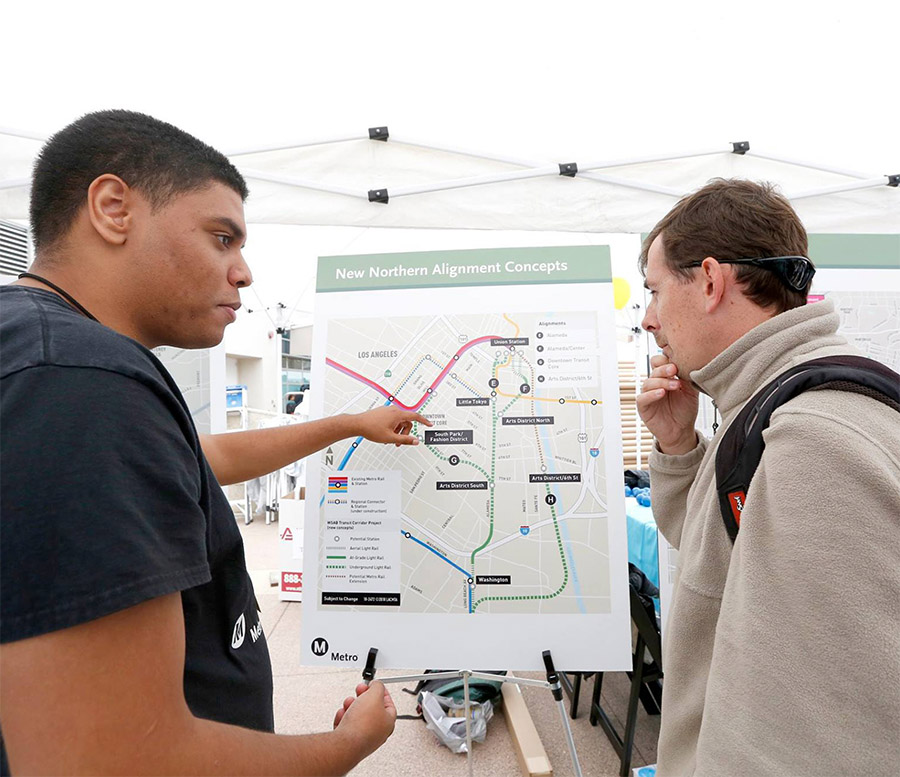
When communities can clearly show the value of transit, they are better positioned to secure the investment needed to expand and improve it. That is the impact of CNT’s recent work in St. Louis, and it is the same framework we are bringing to transit and housing conversations here at home. As the St. Louis region considers the potential installation of their first Bus Rapid Transit line, Citizens for Modern Transit, AARP, and the Saint Louis REALTORS® wanted to answer an important... Continue reading »

Why Housing Affordability Needs a Fuller Measure
For decades, many transportation and land use decisions were shaped by how easily cars could move through a place. In California, and across the country, roadway planning often considered “level of service,” a measure of how well a roadway moves cars and how congested it is for drivers. In practice, this often-encouraged more sparse development to keep congestion was lower, contributing to more roadbuilding, longer commutes, and expanded sprawl. In 2013, California began moving away from... Continue reading »

CNT's Transportation Equity Network Brings Community-Led Engagement to Transport Chicago
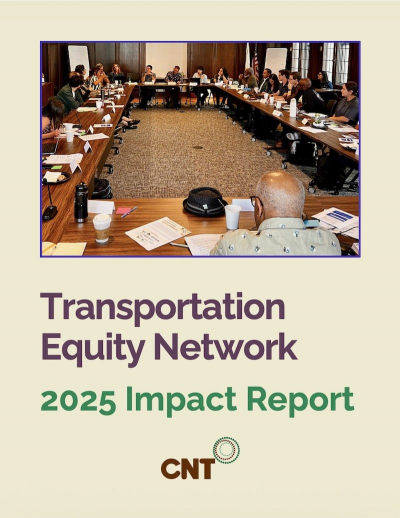
Transportation planning works best when the people most affected by infrastructure decisions have a meaningful role in shaping them. That belief is central to the Transportation Equity Network coalition, known as TEN, which is stewarded by the Center for Neighborhood Technology. Through TEN, community-based organizations have been working with planners at the Chicago Transit Authority and the Chicago Department of Transportation to bring deeper, more meaningful engagement into the heart of... Continue reading »

When Public Data Disappears, Community Power Shrinks
I did not come to this work from the outside looking in. I grew up in Detroit. East Side. I know what it looks like when the systems around you do not work — and when the people responsible for them have information, resources, and answers that never quite reach you. That gap is part of why I became a planner. Not because I saw community as something to serve from a distance, but because I am part of community. That lived experience is the lens I bring to everything I do, including my role... Continue reading »

Visionary Voices podcast on ETOD history and what’s next with NITA
Visionary Voices — gatherings we started in 2024 to share collective efforts to create resilient communities — is going online to produce more generative conversations with community, planning, government, academic and business leaders, moderated by Nina Idemudia, AICP. “You’ve got to speak up. You can’t sit back and fuss and complain, you’ve got to make your concerns known.” That’s wisdom from Jacky Grimshaw, CNT’s senior director who has led the charge on policy... Continue reading »

‘Neighborhood Technology’ equals community-powered solutions
Chief Strategy and Program Officer Miriam Savad, above (at a CNT planning retreat) led our recently-completed theory of change, impact framework and strategic plan process. By Miriam Savad 2025 was by all accounts a disruptive year, ushering in a wave of instability. Yet amid this challenging time, CNT still carved out time to reflect on the purpose and direction of our work: our work is to equitably change systems to support more just, resilient, sustainable and... Continue reading »