 Strengthening Transit Through Community Partnerships
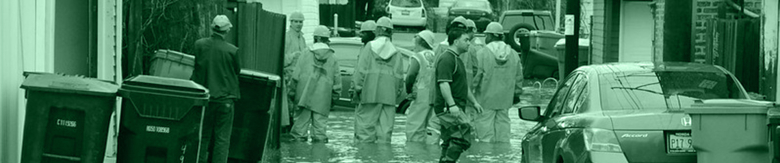
Flooding can feel like bad luck. It isn’t. The rain is getting more intense — climate change is bringing heavier storms in shorter bursts — and its running into infrastructure that was never built for this much of it. Our sewers and drainage systems were designed for a climate we don't live in anymore.
This doesn't fix itself. The flooding keeps coming. And it keeps occurring in the same neighborhoods, over and over, hardest where the least has been invested. At Center for Neighborhood Technology, we don't just talk about flooding — we build ways to see it coming, respond to it, and push for real investment where it's needed most. And because the harm comes in layers, the solutions should too.
A flood is never just a flood. The water goes down, but the damage stays. Mold moves in, health suffers. The things people spent their whole lives working for — the furniture, the photos, the car, the boiler in the basement — get ruined. Insurance goes up, if you can even get it. One flood turns into five different problems, and it’s families who end up carrying all of it.
And that weight isn't shared evenly. The neighborhoods hit hardest are the ones disinvested in for generations — disproportionately communities of color, working families, folks who were already stretched thin. Communities have been telling us this for years, and the data in our new Flood and Sewage Vulnerability Assessment helps document and make those disparities more visible. When you've got less to fall back on, a flooded basement isn't just a headache. It can knock a family's whole footing out from under them. Flooding isn’t only about water. It’s about who gets protected and who gets left to figure it out alone.
The first challenge is knowing where the water actually goes. That's our flood sensor pilot — 50 sensors across Chicago right now, built by Hyfi and powered by Verizon's 5G network. Using sonar, they’re one resource that can help show where flooding is happening in real time, across streets, waterways, and the systems underground. So instead of finding out after somebody's basement is already full, we are closer to seeing how water really moves through a city as it happens. This work is being done with the City of Chicago, and I'm grateful for that partnership — building and learning from pilots is something CNT is good at, and it works best right alongside the people who know how the system runs every day. But I'll be honest with you: a pilot is only ever a beginning. To take something like this past the pilot stage, it has to be funded.
The second hurdle is doing something about the stormwater once you know where it's going. That's RainReady© Calumet, where we've spent years on the ground in Cook County planning, engaging residents, and reducing flooding at the level of the home and the block — the places people live. RainReady© Calumet is funded through American Rescue Plan dollars. That money is temporary — but the infrastructure its building isn't. That's the whole opportunity in a nutshell: a large pot of one-time funding, put to work collaboratively with communities on permanent changes that will protect neighborhoods long after the grant is spent. Temporary money doesn't have to mean temporary fixes.
The third challenge lies in changing the rules and the priorities that got us here. That's the Flooding and Sewage Coalition, where we've organized with partners like the Alliance for the Great Lakes to push for the kind of policy and infrastructure change that no single project can pull off alone. One of the most important changes we advocate for is making sure communities facing multiple, overlapping environmental burdens receive the attention and investment they deserve. That means looking at the full picture of the environmental conditions, stressors, and challenges affecting people’s health and well-being, both inside and outside their homes, and working directly with residents to understand their lived experience. To help identify where these cumulative impacts are greatest, CNT has worked alongside the Coalition and its Community Advisory Committee to develop a Flooding and Sewage Vulnerability Index, which will be made publicly available by the end of 2026.
So, look at the pattern: detect it, respond to it, change the system behind it. That's the strategy. But every piece of it runs into the same wall. To move past pilots and temporary fixes, this work has to be funded for good.
Right now, whether a flood-prone neighborhood gets prioritized can come down to who's paying attention that day: the right alderman, the right meeting, the right person making the case to City Hall. We at CNT don't think protection from flooding should depend on any of that.
What we should be working toward is understanding how capital improvement planning works and building equity directly into the process. That means using metrics that account for who is most affected and directing resources so communities carrying the greatest risk move up the list by design, not because someone had to fight to get them there.
That's the difference between a good decision and a good system. One helps a neighborhood once. The other protects every neighborhood, every budget cycle, whether anyone's watching or not.
And building a better system also requires agencies to plan together. Flooding does not follow departmental or jurisdictional boundaries, so continued collaboration between City departments and MWRD is critical to aligning investments, sharing information, and making sure communities are not overlooked because responsibility falls between agencies. Chicago should use this moment to formalize that coordination, creating clearer shared priorities and accountability so residents are not left navigating fragmented systems on their own.
Chicago has a real opportunity to put these ideas into practice. A new City Council review process for the City's capital improvement plan creates greater public visibility into how infrastructure projects are prioritized. That opens the door to advocate for equity and vulnerability measures to become part of how those decisions are made.
And residents have a role to play in that process. Show up when infrastructure priorities are being discussed. Submit public comments. Ask elected officials how projects are being prioritized and whether the communities facing the greatest risks are receiving their fair share of investment. The more residents understand how these decisions get made, the more power they have to demand a better system.
And that's not a question for Chicago alone. It's a question for every city, county, and agency that gets to decide where infrastructure dollars go. Every level of government has some version of these levers: the budgets, the plans, the priority lists. The work is finding them, making them more transparent, and using them well. Residents can help by asking the same basic questions wherever they live: Who is most at risk? Who is receiving investment? Who is missing from the conversation?
This is the opportunity I want us to keep working toward. When the tools, the funding, community voices, and government priorities finally line up with the need, that's the moment a pilot becomes permanent. That's when a neighborhood actually changes.
Because the solutions already exist. What they need now is the public will, sustained investment, and accountability to make them last.